Posts

FEAR AND ANXIETY

“Anxiety” is a modern term that does not have an exact equivalent in Chinese medicine. There is no Chinese medicine term that corresponds exactly to what we call “anxiety” but several ancient Chinese disease entities closely resemble anxiety.  The four main disease entities that correspond  to Anxiety are: “Fear and Palpitations” (Jing Ji)   惊 悸     “Panic Throbbing” (Zheng Chong)   怔 冲        “Mental restlessness” (Fan Zao)    烦 躁      “Agitation” (Zang Zao)    脏   躁 Fear is the emotion that pertains to the Kidneys and I would like to make three points.  Firstly, “anxiety” does not correspond only to “fear”: it also corresponds to “worry” and “pensiveness” in Chinese medicine. Secondly, we normally say that fear depletes Kidney-Qi and it makes Qi descend.  The Su Wen in chapter 39 says: “ Fear leads to loss of Jing which results in obstruction of the Upper Burner, when this is obstruc...
MEMORY IN CHINESE MEDICINE

Image
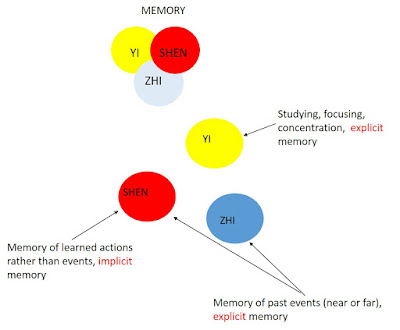
THE SHEN ( 神 ) OF THE HEART The Shen of the Heart plays a prominent role in memory partly by itself and partly because it coordinates the Yi of the Spleen and the Zhi of the Kidneys which also play a role in memory. The Shen of the Heart plays a role in memory in the sense of memorizing but especially also in intrinsic memory (see below). Information that we have to consciously work to remember is known as  explicit memory , while information that we remember unconsciously is known as  implicit memory .  Implicit memory is  not always unconscious as it includes what we call “muscle memory” which in psychology is called “procedural memory” (see below). Explicit Memory When we are trying to intentionally remember something (like the names of acupuncture points or a list of dates for a history class), this information is stored in our explicit memory. We use these memories every day, from remembering information for a test to recalling the date and time of a doctor's ...

Misuse of Prescription Medication is Epidemic

According to the American College of Preventative Medicine, the Misuse and Abuse of Prescription Drugs is Epidemic. The past two decades have witnessed an expansion of pain medication use, especially opioid use for patients who have chronic noncancer pain. 7 million people abuse/misuse prescription drugs every month; pain relievers = 5.3 million. We live in "a pill for every ill” culture. Nonmedical use of Prescription drugs is the defining drug problem of the new century. The increase in diversion of prescription drugs is fueled by: Increased advertising and advocacy  Easy access and availability  Stronger motivations to get high (such as to deal with problems, or work harder and longer) Safety perception that prescription drugs are less harmful than illicit street drugs  Normalization of abuse of prescription drugs in teen culture  Limited liability  Lack of education  High street value  Pain Pill Patients Opioids are the most abused drugs in the ...

Why 12 Step Meetings Work for Sobriety

Image
12 Step Meeting Makers Make It! Once you have completed your in-patient addiction treatment at English Mountain Recovery your recovery program is not over. Recovery is a life long event but completed one day at a time. Over the years we have seen that our most successful clients commit to and attend 12 step meetings on a regular basis. The first thing you will want to do when you return home from treatment, is to go online and check out the available 12 step meetings in your area. Bookmark that page, or better yet print it out. Most AA's pre-schedule their meetings conveniently around work or school schedules. Get a Home-Group Meeting People who have long term sobriety more thank likely are a member of a home-group. A home-group is a meeting you can join and should attend on a very regular basis. Overtime this group will become like family to you, as you get to know people on a personal level. I have attended a 12 step noon meeting for as long as I can remember. In the beginni...

Sugar - The Other Drug?

When we stop drinking alcohol or using drugs we can easily, without warning - replace that addiction with sugar. Satisfying ourselves with a little sugar instead of our previous addiction is easy to justify. The problem is that alcohol and drug addiction share common characteristics with how the body reacts to sugar. How Does Sugar Affect the Brain? Web MD wrote: Sugar gives you a rush, messes with your mind, and always leaves you wanting more - and now researchers are calling for the government to regulate the sweet stuff like a drug. Sounds pretty much just like our former addiction. Is sugar worse for you than, say, cocaine? According to a 2012 article in the journal Nature, it's a toxic substance that should be regulated like tobacco and alcohol. Researchers point to studies that show that too much sugar (both in the form of natural sucrose and high-fructose corn syrup) not only makes us fat, it also wreaks havoc on our liver, mucks up our metabolism, impairs brain function, ...

GERIATRICS IN CHINESE MEDICINE

The thinking about geriatrics in Chinese medicine has been dominated by Kidney deficiency for centuries. As Kidney-Jing declines as we age, the clinical approach to the treatment of the elderly has been based largely on tonifying the Kidneys. However, modern diseases of the elderly that account for 90% of mortality (cancer, heart disease and stroke) are characterized by Fullness. Quite simply, we do not die of Kidney deficiency but of Phlegm, Blood stasis and Internal Wind. The most common pathogenic factors (and those leading to serious diseases) are: Phlegm Blood stasis Internal Wind Apart from the major diseases of the elderly such as cancer, stroke and heart disease, very many symptoms and signs that occur in old age are caused by Phlegm and/or Blood stasis. The following is a partial list. GERIATRIC SYMPTOMS/SIGNS •Otosclerosis: Phlegm/Blood stasis •Cataract: Phlegm •Macular degeneration (vascular, lack of blood nourishment): Blood stasis •Dry eyes: may be due to Blood stasis •Alz...

Top 5 Tips for Staying Sober this Holiday Season

Image
1. Attend 12 Step Meetings Most 12 step groups hold additional meetings during the holidays and sober parties. Keep your 12 step meeting schedule handy on your phone and make a plan. Remember - nothing ensures continuous sobriety better than one alcoholic talking to another alcoholic. 2. Remove Expectations During this time of year, we can place a lot of expectations on others as well as ourselves. Remember the Alcoholics Anonymous slogan, "easy does it". Relax and take the pressure off yourself and those around you. Enjoy the season! 3. Start A New Holiday Tradition Why not start a new tradition and host your own sober holiday event? Invite your sober friends over and have them bring their favorite dish. Before you eat read a paragraph from the Big Book and let everyone share. Nothing breaks the ice better than a meeting! 4. Don't Go to Slippery Places There is an old saying in Alcoholics Anonymous - Don't go to the barber shop unless you want to get a haircut!...